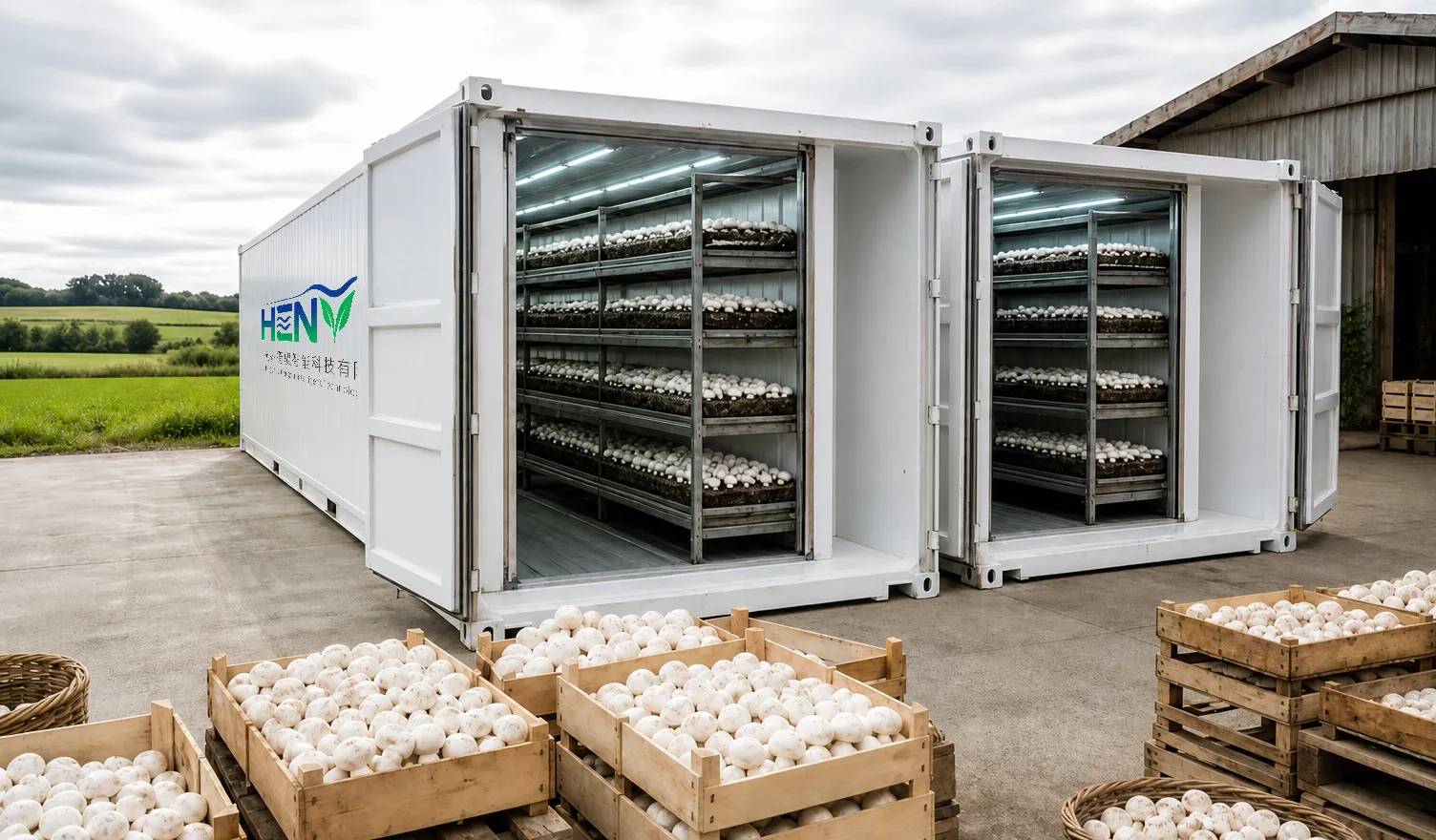
Mushroom containers have been automated in climate control, irrigation, monitoring and even substrate handling, but the harvest itself remains stubbornly manual in essentially every commercial operation. Understanding why reveals the practical shape of the labour cost in this business, and it clarifies which parts of the process are genuinely amenable to automation and which are not.
The Biological Case Against Mechanisation
A robotic arm cannot easily be instructed to harvest a mushroom cluster. The difficulty is not the grasping motion; it is the judgement.
Mushrooms do not ripen in unison. On a single block, individual fruiting bodies reach marketable size over a period of days, so a given block must be visited repeatedly and selectively harvested rather than stripped once. A harvester assesses each cluster, decides which fruits are ready, cuts them at the base with a knife, and leaves the remainder to mature. This decision requires visual assessment of size, maturity, cap opening, colour and firmness, plus a judgement about whether cutting will damage adjacent developing fruits.
Add to this the physical sensitivity of the crop. Mushrooms bruise on impact and on compression, and a bruise that is invisible at harvest becomes a visible blemish hours later. The tissue is soft, irregular in shape, and clustered densely enough that access to a single fruit may require manipulating neighbours. Handling forces must be low and precise.
The result is that the manual harvester's combination of perception, judgement and gentle dexterity is not merely cheaper than the alternative; it is currently the only method that works at commercial quality standards.
Labour Arithmetic
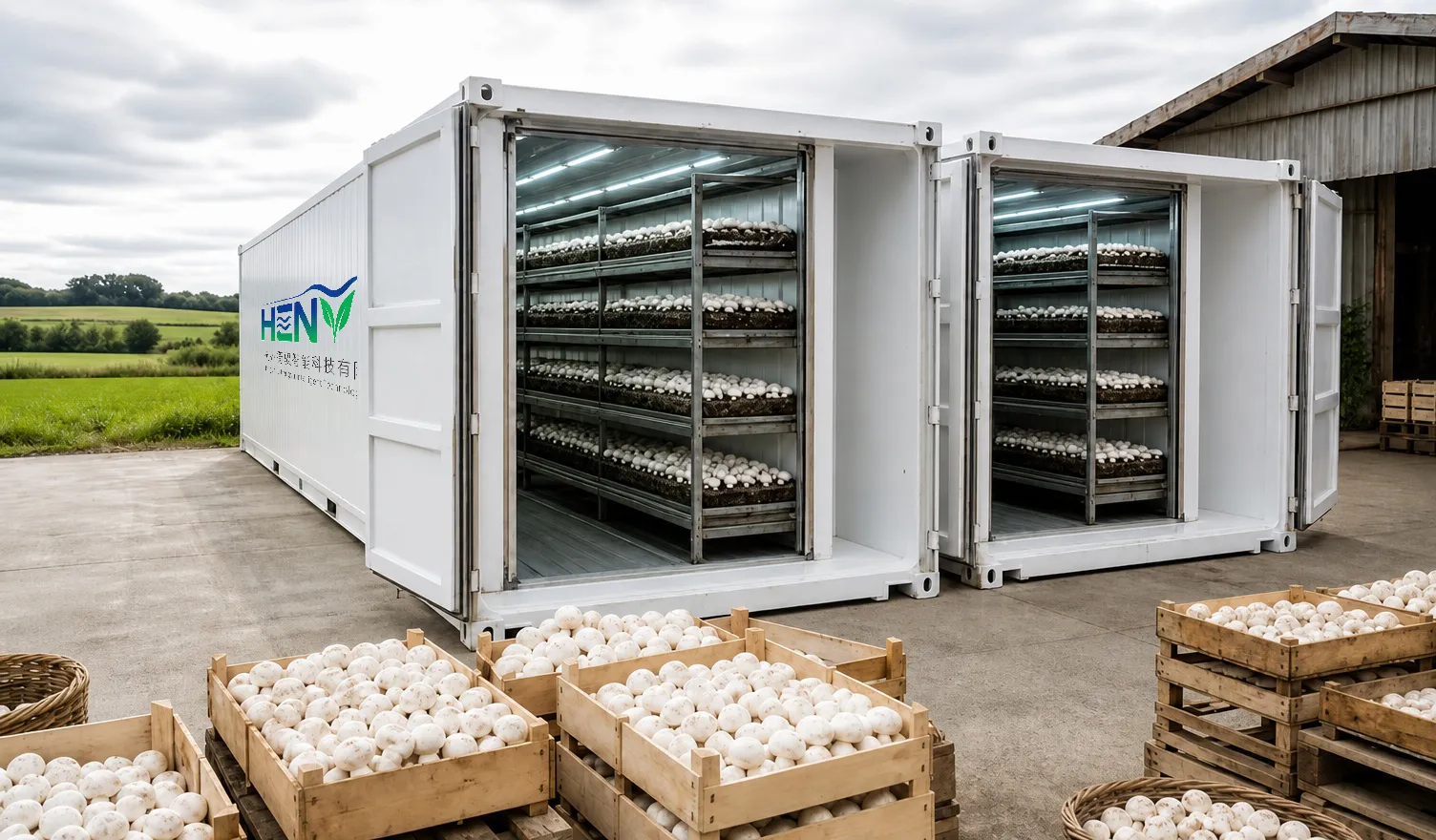
The labour consequence is significant. Harvesting, grading and packing are the dominant labour inputs, and their share of total operating cost rises as climate control is automated. In a well-run leafy-green container, the crop is a uniform canopy that can be handled in bulk and in predictable cycles. In a mushroom container, workers move through the racks repeatedly, on a schedule dictated by the crop rather than by the production plan, selecting a fraction of what they see.
The practical metric is labour hours per kilogram of harvested product, and it varies widely with species, container layout, handle height and the skill of the workforce. Layout choices that seem trivial — rack spacing, tray accessibility, the height at which the working band sits — materially affect how many kilograms a worker can pick in an hour, and therefore affect unit cost more than many equipment decisions.
Staging and the Rhythm of a Flush
Mushrooms fruit in flushes: a heavy first flush, followed by lighter subsequent ones, with periods between. Across a container filled with blocks that were inoculated on different days, flushes are staggered, which smooths the harvest workload and the market supply. This staggered scheduling is essential. A facility that inoculates all its substrate on the same day will produce a single enormous harvest, followed by an idle period — a pattern that wastes labour, overwhelms the cooling and packing capacity, and delivers a supply curve no customer wants.
Getting the stagger right is an operational discipline that determines how evenly the workforce, the cold store and the delivery schedule are loaded.
What Can Be Automated
While harvesting resists automation, a great deal of surrounding work does not.
Climate control is the most obviously automated area, and modern controllers handle the interaction of cooling, humidification, fresh-air exchange and carbon dioxide management without continuous operator intervention.
Environmental monitoring and alerting is similarly mature: continuous logging of temperature, humidity and CO2 provides both an audit trail and early warning of equipment drift.
Substrate handling upstream of the container can be substantially automated where volumes justify it, including mixing, bagging, sterilisation loading and inoculation under laminar flow. This is where capital investment in automation produces the clearest return, because the operations are repetitive, the throughputs are high and the precision requirements are uniform.
Irrigation, where liquid culture or supplemented systems are used, is straightforward to automate. Spore-load monitoring and filter pressure-drop monitoring allow maintenance to be scheduled on condition rather than on a calendar.
In the last few years, machine vision has begun to be applied to assessment tasks: estimating size distribution and readiness within a rack, flagging contamination in a batch, and providing harvest forecasts that inform scheduling. These systems are decision-support tools rather than replacements for hands, and that is likely to remain the case for some time.
Ergonomics and the Working Environment
Because the container is a confined space with high humidity, low temperatures during fruiting and elevated spore loads, the working environment itself is a design consideration.
Rack heights should place the productive band within a comfortable reach envelope, because large volumes of harvest work are performed at or above shoulder height and repetition injuries are common in the sector. Access aisles must allow a worker to move with a harvesting tray or container without awkward twisting. Lighting at the working face must be sufficient to judge maturity and to detect defects, which introduces a modest lighting requirement that has nothing to do with the crop's development.
Spore exposure during harvest is at its highest, which means exhaust ventilation should be running at full rate during picking, and protective equipment should be issued as standard rather than as an option.
The Cold Chain Handover
Harvested mushrooms begin deteriorating immediately. They are roughly ninety per cent water, have no protective skin, and transpire freely. Pre-cooling to 2 to 4 degrees Celsius should begin as soon as possible after cutting, and the interval between harvest and the start of cooling is a controllable quality variable.
For a container operation, the practical design implication is that the container should be sited adjacent to its cold store and packing area, or that a fast transfer route should be engineered. Packaging in breathable film, avoiding compression in transit boxes, and maintaining consistent cold temperatures through to the customer are unglamorous logistics that determine whether the product arriving at a restaurant kitchen matches the quality that left the container.
Where Automation Is Heading
The trajectory in the sector runs from assistance rather than replacement. Vision systems that count and size fruit, that flag contamination earlier than the human eye, and that generate yield forecasts. Robotic systems that move trays and containers to bring the crop to a stationary worker rather than requiring the worker to move through the racks. Cutting devices that assist the motion of a knife rather than replacing the hand that guides it.
Each of these shifts labour rather than removing it, and each requires the crop, the tray and the rack to be designed for it from the outset. The most important automation decision in a mushroom container project is therefore often made at the design stage, in choosing a layout that a future robot can operate within — not in the procurement of the robot itself.