Introduction
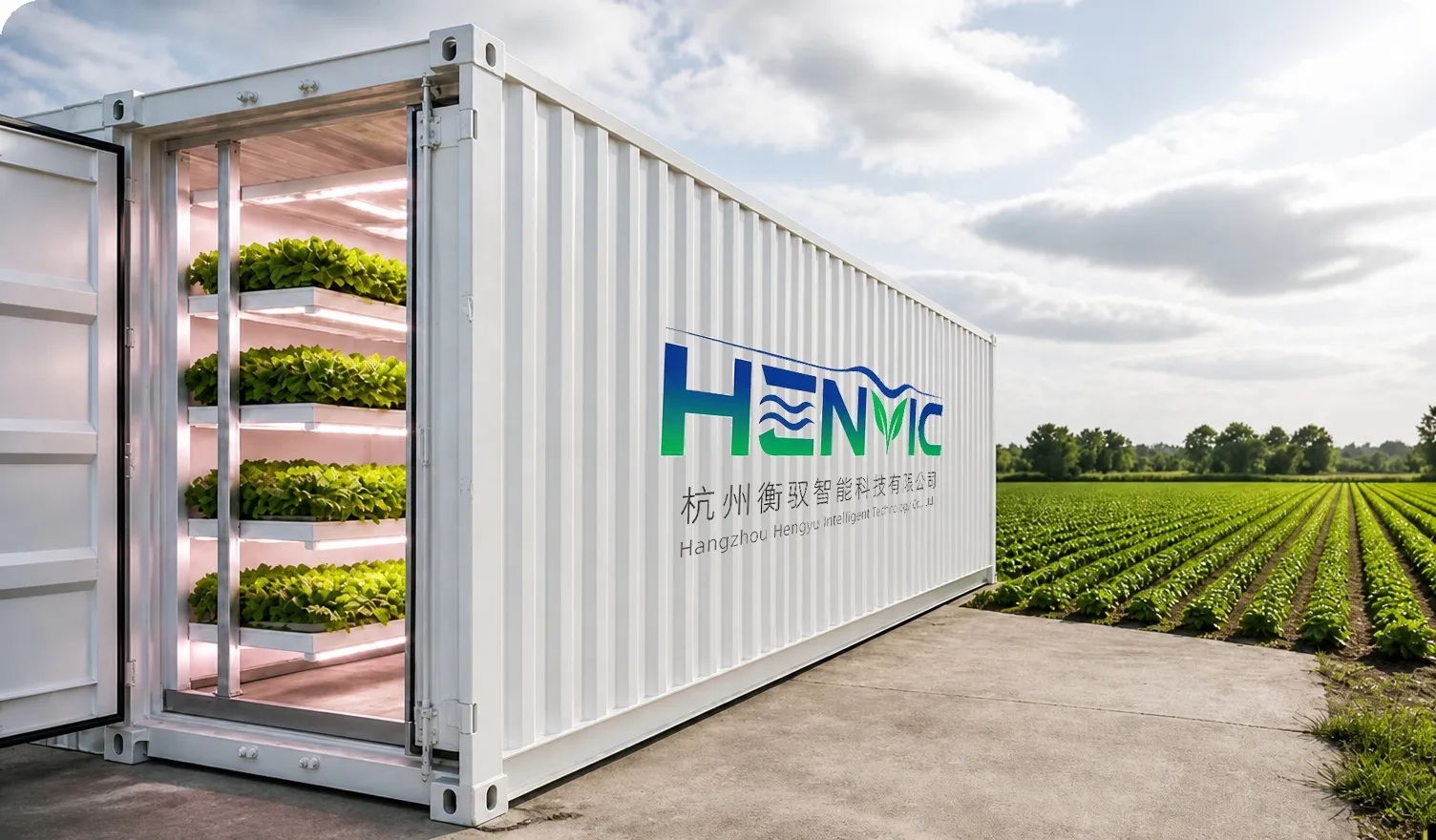
Ask a field farmer how long lettuce takes and the honest answer is: it depends on the weather. Ask a container farmer and the answer is a number — twenty-eight to thirty-five days, every time, all year. That predictability is the whole point. When you stack layers of hydroponic growing channels inside an insulated shipping container and drive them with tuned LED light, a head of lettuce stops being a seasonal crop and becomes a manufactured product with a fixed lead time.
Thirty days per turn, twelve turns a year, in the same thirty square meters of steel. This article is about how vertical hydroponics and the container envelope combine to create that rhythm — the growing system, the lighting, the climate and nutrient control, the daily cycle, and the economics that decide whether the factory runs at a profit.
Why Thirty Days Is the Magic Number
Lettuce's short cycle is not a curiosity; it is the foundation of the business model.
Fast turnover means frequent cash flow. A crop that finishes in a month can be sold twelve times a year from one footprint, whereas a fruiting crop might yield two or three harvests. Capital equipment is amortized over far more production cycles.
Short cycles are forgiving in the aggregate. If one tray underperforms, the loss is a month of one channel, not a season. The operator can adjust the recipe and see results within weeks.
Size suits vertical stacking. Greens stay small and low, which is exactly what multi-tier racking needs. Tall crops would defeat the three-dimensional design that makes the container work.
Premium pricing rewards freshness. Greens are perishable and comparatively expensive per kilogram when sold fresh and local. The container's proximity to market — often measured in kilometers, not continents — is a large part of what the buyer pays for.
The Growing System: Hydroponics Inside a Box
Soil plays no role. Inside a container, roots live in a nutrient solution, and the choice of delivery method shapes nearly everything else.
Nutrient Film Technique (NFT) is the workhorse for lettuce. A shallow, continuously flowing film of nutrient solution runs down sloped channels, and plant roots rest in the film, absorbing water and minerals. NFT is lightweight — a real advantage when the channels sit four tiers up — and it makes root inspection easy, which matters for disease management. Its weakness is forgiveness: a pump failure can dry roots in minutes.
Deep Water Culture (DWC) suspends roots in an oxygenated reservoir. It is simple, thermally stable, and buffered against short interruptions, which makes it a common choice for herbs and small heads.
Ebb-and-Flow periodically floods and drains a tray, oxygenating roots with each cycle and reducing pump duty.
Substrate plugs — rockwool, coco coir, peat, or stabilized foam — are used mainly for germination and the first two to three weeks, after which seedlings are transplanted into the main hydroponic system. The plug stays with the plant, providing a stable collar at the channel opening.
In nearly all cases, the solution is recirculated, filtered, and treated with UV, ozone, or peroxide to keep pathogens in check. Water recovery is typically 90–95 % efficient, one of the model's strongest environmental credentials.
LED Lighting: The Sun, Replaced
With no windows, light is an engineered input, and it is the greatest determinant of yield.
Spectrum. Leafy greens thrive on a blend weighted toward red (~660 nm) and blue (~450 nm), with small amounts of far-red and green. Blue drives compact habit and leaf thickness; red drives biomass; far-red nudges leaf expansion. Modern fixtures can be tuned per growth stage.
Intensity. Expressed as PPFD (photosynthetic photon flux density), lettuce generally wants 150–300 µmol/m²/s at canopy level. Intensity is set by how close the fixture can sit to the canopy — which is why multi-tier racking keeps lights low and dense.
Daily light integral (DLI). Intensity multiplied by photoperiod gives DLI, the total light delivered per day. Lettuce targets 12–17 mol/m²/day, typically delivered across a 14- to 18-hour photoperiod. DLI is the single most useful number for tuning yield.
Efficiency. Contemporary horticultural LEDs reach 2.5–3.5 µmol/J, meaning most of the electricity becomes usable photons rather than heat. This efficiency is largely why container farming became viable in the first place.
Placement. Fixtures sit on each tier, close to the canopy, maximizing delivered light per watt while keeping radiant heat out of the growth zone.
Climate and Root-Zone Control
A sealed container is a closed climate loop, and its variables interact tightly.
Air temperature is held near 18–24 °C for lettuce, with slightly cooler nights. Warm air accelerates bolting — the lettuce's rush to flower — which ruins market value.
Root-zone temperature is controlled separately, usually 18–22 °C. Cool roots suppress pathogens; warm solution and oxygen-depleted water cause root rot, the most common failure mode in recirculating systems.
Humidity and VPD. Relative humidity typically sits at 60–75 %. The better control variable is vapor pressure deficit (VPD), which governs transpiration. Leafy greens perform best around 0.8–1.2 kPa. Because a sealed box traps transpired moisture, dehumidification is not optional — it is continuous.
CO₂ enrichment. Raising carbon dioxide to 800–1,200 ppm can lift growth 15–30 % when light and nutrients are not limiting. In a sealed volume, enrichment is far more efficient than in a ventilated greenhouse, where the gas escapes.
Airflow. Horizontal fans prevent stagnant boundary layers and microclimates, strengthening stems and evening out growth across the tray.
Nutrient Management: The Chemistry of a Fixed Schedule
Because the crop's needs are known, the solution can be prescribed.
Electrical conductivity (EC) of roughly 1.2–2.0 mS/cm tracks total dissolved salts; it rises as plants drink water faster than they absorb nutrients, so fresh water must be added continuously.
pH is held between 5.5 and 6.5, the window where iron, calcium, magnesium, and the micronutrients remain available. Drift outside the range produces deficiency symptoms that look like disease.
Dosing is automatic, driven by EC and pH probes: stock solutions are injected as the controller corrects toward setpoints. This closes the loop and removes the guesswork that dominates soil-based growing.
The Thirty-Day Rhythm
A working container farm runs to a schedule, and every stage has a prescribed window.
Day 1–3: Germination. Seed is placed in plugs or a separate warm, humid germination chamber, held around 20–22 °C and saturated humidity until radicles emerge.
Day 3–10: Seedling establishment. Small plants move under modest light and gentle nutrient strength, developing roots and true leaves. Light intensity ramps up gradually.
Day 10–28: Rapid growth. Plants occupy the main hydroponic channels. This is the phase of maximum resource consumption — full light, full nutrient strength, and daily attention to VPD, EC, and pH.
Day 28–35: Finish and harvest. The final week tightens conditions: nutrient may be tapered, temperature managed to prevent bolting, and light tuned for color and leaf texture. Harvest is by hand or semi-automated shear, typically the morning of delivery.
Sowing continuously, harvesting continuously. Well-run operations stagger crops by tray or tier, so seeding, transplanting, and harvest happen every day and every day produces saleable output. The thirty-day cycle is not a batch; it is a rolling factory line.
Automation and the Digital Layer
The rhythm only holds if the variables hold, which is why automation is not a luxury.
Sensors track air temperature, humidity, CO₂, VPD, EC, pH, dissolved oxygen, and light intensity and spectrum. Controllers — PLC or building-management systems — schedule photoperiods, drive fertigation, coordinate ventilation against refrigeration, and log every deviation. Remote dashboards allow one operator to supervise several containers at once, and alerting catches the pump failure or the door left open before it becomes a lost crop. Robotics, where deployed, take on the heaviest labor: seeding, transplanting, and harvesting.
The return on automation is measured in labor per kilogram, and labor is the cost most easily removed from a vertical farm.
Energy, Economics, and the Real Constraints
Electricity is the dominant recurring cost, with lighting and cooling together accounting for 60–80 % of operating expense. A container farm may draw 30–60 kW continuously, so siting on a low-tariff grid or behind a solar array changes the economics more than almost any operational improvement.
Capital cost for a turnkey leafy green container runs from roughly 150,000, depending mainly on automation level, tier count, and lighting quality.
Yield is modest in absolute terms — often several hundred to a few thousand heads per week — but sold into restaurants, grocers, and subscription channels, that volume supports a viable niche business. Competing with field-grown commodity lettuce on price is generally not the goal and not advisable.
Utilization is the quiet lever. An empty tier earns nothing; the crop schedule must be backfilled continuously and matched to demand.
Sustainability: A Short, Clean Supply Chain
Container leafy greens use 90–95 % less water than field production because recirculation captures nearly everything the plants do not take up. There is no soil erosion, no agricultural runoff, and — because the box is sealed — no pesticide drift. Production near the point of consumption collapses food miles, and harvest-to-delivery gaps shrink from weeks to hours.
The environmental cost sits in electricity. Pairing the container with renewable generation, or heat recovery from nearby waste-heat sources, is the central sustainability lever.
Conclusion
A thirty-day salad factory is what happens when two mature technologies meet: the shipping container, standardized and insulating, and vertical hydroponics, dense and precise. Together they convert a fixed date on the calendar into a fixed position on the production line — seed in, greens out, twelve times a year, in the same steel box.
The crop is simple; the system is not. What separates a profitable container farm from an expensive stack of trays is discipline in three places: light delivered to the right DLI, climate held inside a narrow VPD and temperature band, and chemistry dosed automatically so that no variable is ever left to chance. Get those right, and the thirty-day cycle stops being a target and becomes an operating fact.